Rainfrog AI is a web based creative studio that turns your products, characters, and style references into reusable assets, then mixes them on a visual node canvas to generate campaign ready images and videos. The core idea is that you never write a prompt. You connect assets, and the tool builds the prompt for you.
If you run an ecommerce store, a fashion brand, or a marketing agency, you know the pain of keeping faces, products, and lighting consistent across a whole campaign set. Generic AI image tools give you one pretty image and then a fight to match the next one. Rainfrog tries to fix that with asset libraries and drag and drop workflows.
This Rainfrog AI review covers how the tool works, the key features, real pros and cons, the current AppSumo lifetime deal, who it is for, and how it compares with the main alternatives. Everything here is based on the AppSumo listing, the official website, and the company’s own announcements as of August 2026.
Key Takeaways
- Rainfrog AI removes prompt engineering from AI image creation. You connect product, character, style, and environment nodes on a canvas, and the workflow writes the prompt for you.
- Reusable asset libraries are the heart of the tool. They keep products and faces consistent across campaigns, which is the hardest part of AI visual work.
- The AppSumo lifetime deal starts at $59 for 800 monthly credits, with higher tiers at $139 and $299.
- It is built for art directors, ecommerce teams, and agencies, not for developers or casual one-off image users.
- It is still early stage: founded in January 2026, rated 3.7 out of 5 from 8 AppSumo reviews, with consistency and workflow organization flagged as weak spots.
What Is Rainfrog AI?
Rainfrog AI is a web based, node-based AI creative studio for art directors and brand teams. It was founded on January 11, 2026 in Dubai, UAE, and it is a bootstrapped startup with a team of 1 to 10 people. Co-founder Filippo Pietrantonio built it with his brother Leone, who runs a Milan design studio producing fashion campaigns for top fashion brands, according to the founder’s post on the AppSumo listing. You can explore the product on the official Rainfrog website.
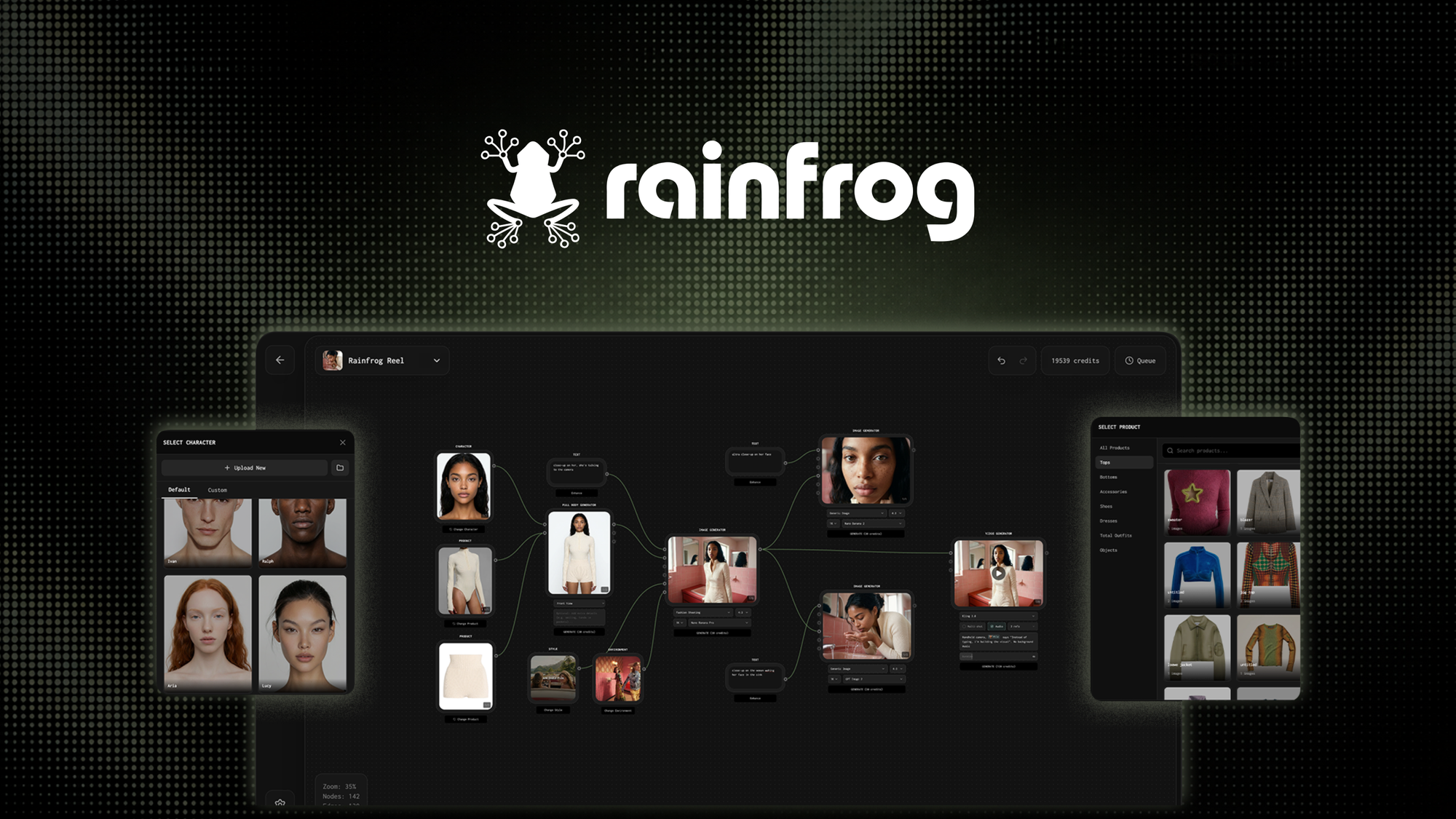
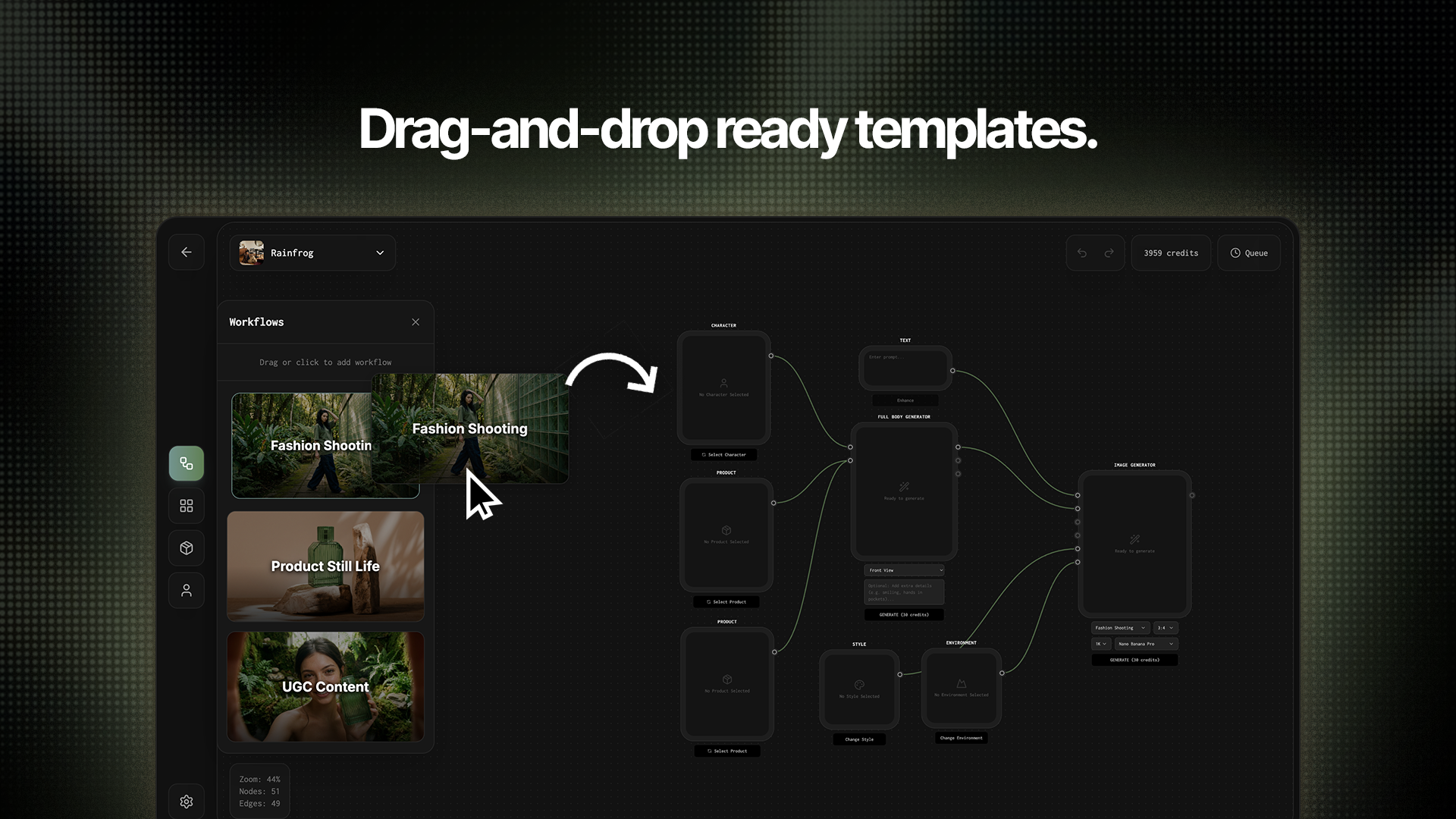
Here is how it works. You upload products, characters, styles, and environments once. Rainfrog analyzes and tags each asset so its context travels with it. Then you build a node graph on the canvas, connecting asset nodes to generator nodes. Rainfrog walks the graph, assembles the prompts automatically, runs image or video generation, and saves the results to your project library.
What makes it different from the usual AI image tools is the absence of a chat box. Instead of typing prompts, you give directions visually. The founder says the system was trained on a proprietary archive of real luxury brand campaign work, so outputs default to considered rather than generic AI. It is early, and the company says MCP and API access are coming soon, but they are not available yet.
Key Features
Prompt-Free Node Workflows
The main feature is the visual workflow canvas. You mix products, characters, styles, and environments by dragging and dropping nodes, and the connections build the prompt automatically. That matters because prompt skill stops being a bottleneck. A designer who knows art direction but hates writing AI prompts can still produce a full campaign. The trade-off is a learning curve: you need to set up your node graph correctly, and reviewers note that workflow organization can get messy as projects grow.
Reusable Asset Libraries
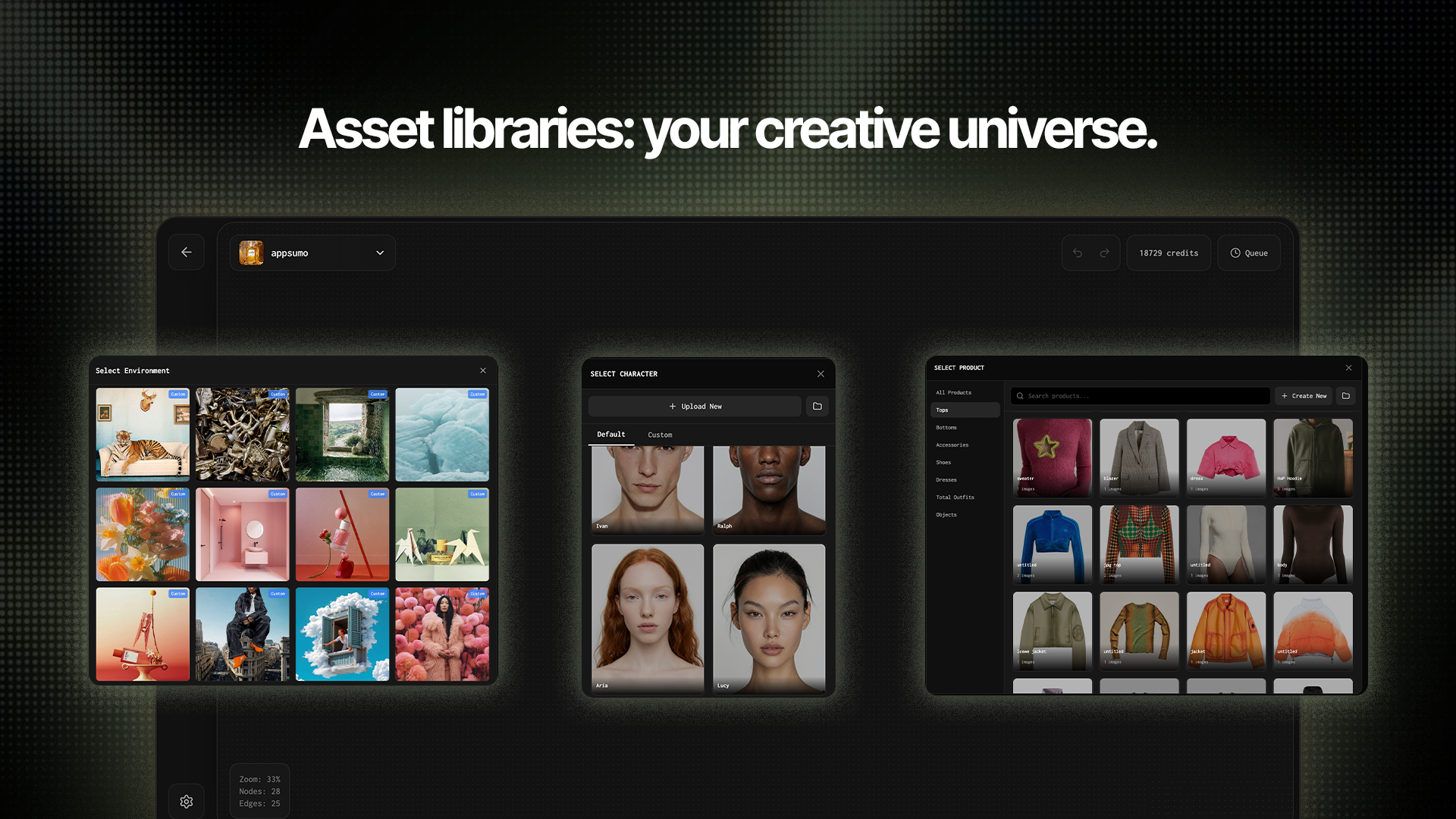
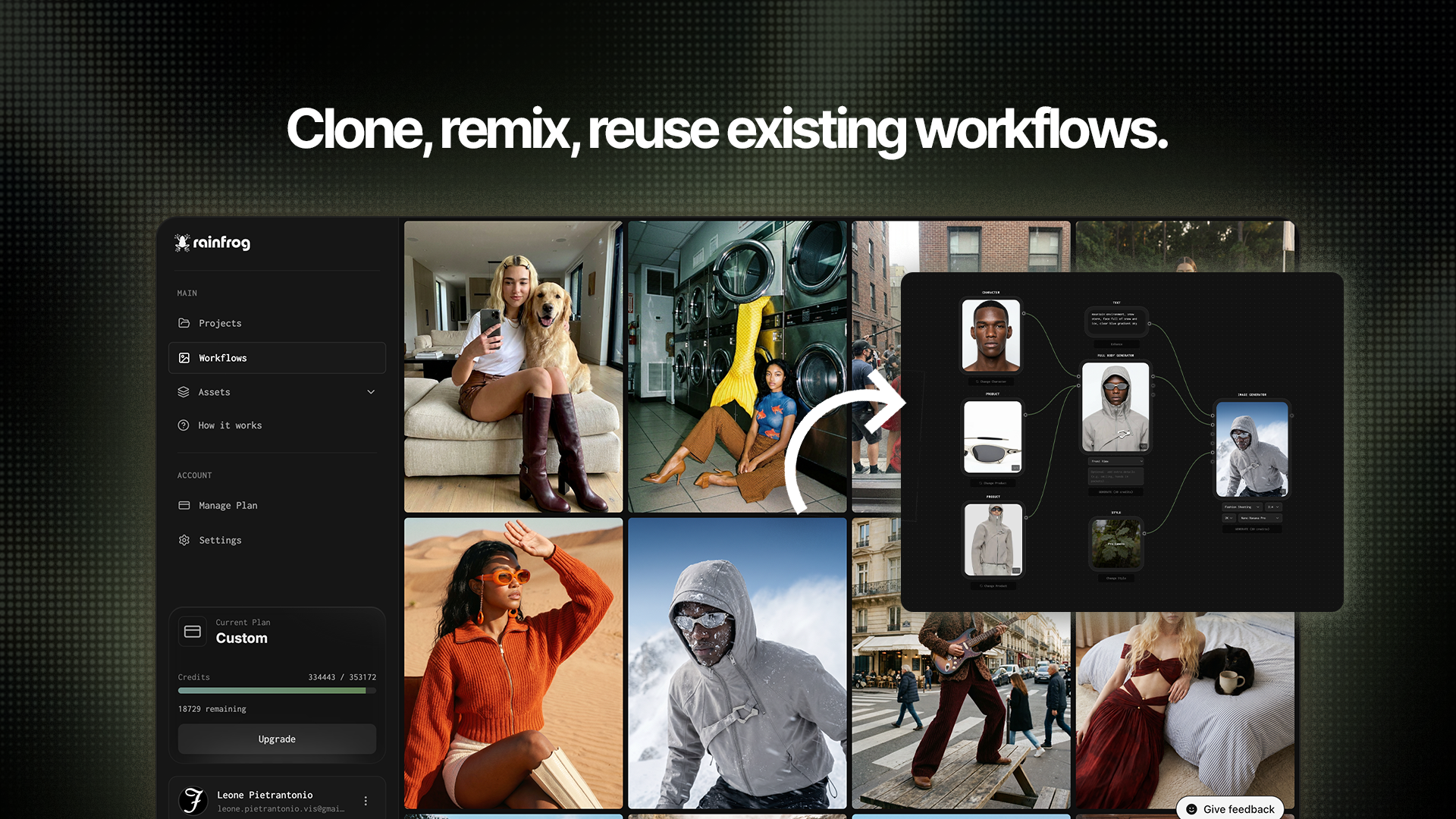
You upload products, characters, environments, and visual references once, and Rainfrog keeps them ready for any workflow. Assets are automatically analyzed and tagged, so their context follows them into every configuration. You can swap characters, products, and environments freely to explore directions without starting over. This is what makes consistent faces and products possible across dozens of variations, the thing most AI image tools struggle with. The honest caveat from AppSumo reviews is that reference image consistency can still slip in some cases.
Clone and Remix Preset Workflows
Rainfrog ships preset templates like Fashion Shoot, Product Still Life, and UGC Content. You can clone a preset workflow to kick off a new project from visual inspiration instead of a blank canvas, then remix layouts, styles, and environments. This is the scaling play: agencies can reuse a proven workflow across many clients and campaign types without rebuilding art direction each time.
Image and Video Generation With Top Models
Rainfrog works with a selection of AI models, including Nano Banana, Seedream 5, GPT Image 2, Kling 3.0, and Seedance 2. It picks the best model for each task, and you can choose normal or pro quality per generation node. The AppSumo listing also lists Google Gemini and OpenAI as integrations. The practical benefit is that you get image and video generation in one place without juggling several subscriptions. The cost side is credits: every generation consumes credits, and monthly credits do not roll over.
One Canvas for Every Format
You can produce UGC, product visuals, organic content, and full productions inside one canvas. Products and characters stay consistent across projects while you are free to change direction. For an ecommerce team, that means the same model can appear in a product still life, a lifestyle scene, and a short video clip without looking like three different people.
Pros and Cons
Pros
- No prompt engineering needed. The node graph writes the prompts for you.
- Asset libraries keep products, faces, and environments consistent across a campaign set.
- Cloneable preset workflows speed up new projects, from Fashion Shoot to UGC Content.
- Image and video generation in one tool with a strong model selection.
- Lifetime deal with a 60 day money-back guarantee, so you can test it risk free.
Cons
- Very new company, founded in January 2026, with only 8 AppSumo reviews so far.
- Reviewers report occasional reference image consistency issues.
- Workflow organization can get messy as projects grow.
- Monthly credits do not roll over, so unused credits are lost.
- The entry tier limits you to 6 projects, 25 products, 10 characters, and 15 environments.
- No public MCP or API access yet, which limits automation for power users.
Pricing and AppSumo Deal
The Rainfrog AI listing shows a regular price of $130, and the AppSumo lifetime deal starts at $59. There are three lifetime tiers, and every tier includes normal and pro models, video generation, preset workflows, and custom libraries. Credits are monthly and do not roll over.
| Feature | Tier 1 | Tier 2 | Tier 3 |
|---|---|---|---|
| Price | $59 | $139 | $299 |
| Monthly credits | 800 | 2,000 | 4,200 |
| Projects | 6 | 25 | Unlimited |
| Products in library | 25 | 100 | Unlimited |
| Characters | 10 | 40 | Unlimited |
| Environments | 15 | 50 | Unlimited |
| Storage | 5 GB | 10 GB | 20 GB |
| Image models | Normal + Pro | Normal + Pro | Normal + Pro |
| Video generation | Included | Included | Included |
| Preset workflows | Included | Included | Included |
| Custom libraries | Included | Included | Included |
The deal gives you lifetime access with all future Hobby plan updates for Tiers 1 and 2, and Pro plan updates for Tier 3. If the plan name linked to your deal changes, it transfers automatically. You need to activate your license within 60 days, you can upgrade while the deal is live, and you can downgrade within 60 days of purchase. AppSumo’s 60 day money-back guarantee covers the whole purchase. Before you commit, check the current Rainfrog AI offer on AppSumo.
A note on reputation: Rainfrog AI is rated 3.7 out of 5 from 8 AppSumo reviews. The distribution skews to the middle, with four 3-star reviews, two 5-star reviews, and two 4-star reviews. The AppSumo summary describes an intuitive interface and reusable workflows with strong creative potential, balanced against reference image consistency and workflow organization issues.
Who Is It Best For?
Rainfrog is a specialized tool with a clear audience. Here is who gets real value from it and who should look elsewhere.
Good Fit
- Ecommerce stores that need consistent product shots for new variants and drops.
- Fashion and lifestyle brands that shoot campaigns with models and environments.
- Agencies producing campaign sets for multiple clients without redoing art direction each time.
- Marketers and creators who want UGC-style and organic content without strong prompting skill.
- Teams already using all-in-one AI creative suites like ArtSpace AI who want a more directed visual workflow.
Not a Good Fit
- Developers who want to call AI models directly through an API. MCP and API access are coming soon, not here yet.
- People who need only occasional one-off images. The monthly credit model rewards steady use.
- Teams that need strict brand-consistent output today and cannot tolerate occasional reference drift.
- Budget shoppers who expect unlimited everything at the entry price. Unlimited projects, products, and characters require the $299 tier.
Is Rainfrog AI Worth It?
For its niche, yes. The prompt-free workflow and the asset libraries solve a real problem: consistent campaign visuals at scale. Compared with the cost of a traditional photoshoot or the hours spent prompt engineering a generic AI tool, a lifetime license is inexpensive. The tool also has a visible early community, including a Rainfrog Product Hunt listing, which is a useful signal for a young product.
The honest caveats matter too. The company is months old, the review count is small, the rating skews to the middle, and the credits do not roll over. If your workflow depends on perfect reference consistency today, test it on your own assets first. That is easy to do because the AppSumo purchase is refundable for 60 days.
My verdict: Rainfrog AI is worth it if you produce branded visual content regularly and will invest time in building your asset libraries. It is a weaker fit for casual users or teams that need a more proven product with deeper reviews.
Alternatives
Adobe Photoshop
AppSumo lists Adobe Photoshop as a direct alternative. Photoshop gives you total pixel control and its generative AI features, but it comes with a subscription cost and a steep learning curve. It does not manage product and character consistency the way Rainfrog does, so you still do the coordination work yourself.
Canva
Canva is the other alternative AppSumo names. It is easier for quick social graphics and template-based design, and Magic Studio adds AI helpers. But Canva is template-centric, and it is less suited to keeping one model’s face consistent across dozens of campaign shots from your own uploaded assets.
Midjourney
Midjourney remains one of the strongest prompt-based image generators, with excellent quality and style control. The catch is that it demands prompt skill, and it is not built around your own product and character asset libraries. Rainfrog trades some raw image quality for a workflow that keeps your brand assets central.
AI UGC Video Tools
If your priority is UGC-style video rather than campaign imagery, dedicated AI UGC video tools like Yorby focus on scripts and AI-generated UGC clips. Rainfrog is stronger on visual consistency for product and character imagery, with video generation layered on top rather than being the main event.
Final Verdict
The main reason to buy Rainfrog AI is the prompt-free, asset-first workflow that keeps products and characters consistent across a campaign set, at a lifetime price. The main reason to skip it is that it is a very young product with a small review base and credit-based limits, so it suits steady, brand-focused creators more than casual or automation-heavy users.
FAQ
What is Rainfrog AI?
Rainfrog AI is a web based, node-based AI creative studio for art directors and brand teams. You connect products, characters, styles, and environments in a visual workflow, and it generates campaign ready images and videos without prompt engineering.
How much does the Rainfrog AI AppSumo deal cost?
The lifetime deal starts at $59 for Tier 1, with Tier 2 at $139 and Tier 3 at $299. Every tier includes normal and pro models, video generation, preset workflows, and custom libraries, with credits that reset monthly.
What AI models does Rainfrog AI use?
Rainfrog combines models including Nano Banana, Seedream 5, GPT Image 2, Kling 3.0, and Seedance 2. It selects the best model for each task, and you can choose normal or pro quality per generation node.
Do Rainfrog AI credits roll over each month?
No. Monthly credits do not roll over, so unused credits are lost at the end of each cycle. That makes the tool better suited to regular, ongoing creative work.
Is Rainfrog AI good for ecommerce product photos?
Yes, if you upload your products to the library and build workflows around them. The tool is designed to keep products and characters consistent across variations. Just check your tier limits, since Tier 1 caps you at 25 products and 6 projects.
Can I try Rainfrog AI before buying the AppSumo deal?
Yes. The official site offers a free account at app.rainfrog.ai so you can explore the studio. Paid plans are Hobby, Pro, and Ultra, and the AppSumo lifetime tiers map to Hobby for Tiers 1 and 2 and Pro for Tier 3.